A Coal Mining Legacy
For more than two centuries, coal mining shaped the landscape and livelihoods of Broughton and the surrounding villages. This page brings together the stories of the collieries that powered our community – their origins, their people, and the events that marked their histories.
Collieries Directory
(Click the links below)
Also known as Poolmouth Colliery, this was a family-owned drift mine which was driven into the eastern side of Poolmouth Valley, close to the boating lake in Moss Valley Country Park. Robert Evans and his son Thomas purchased the plot from the Brynmally Estate in 1926. It was a productive concern until the early 1940s when the mine experienced flooding problems. In October 1934 David Evans, the youngest of Robert Evans three sons, entered a shed where explosives were kept with a cigarette in his mouth. He was killed in the resulting explosion at the age of 37 years old.

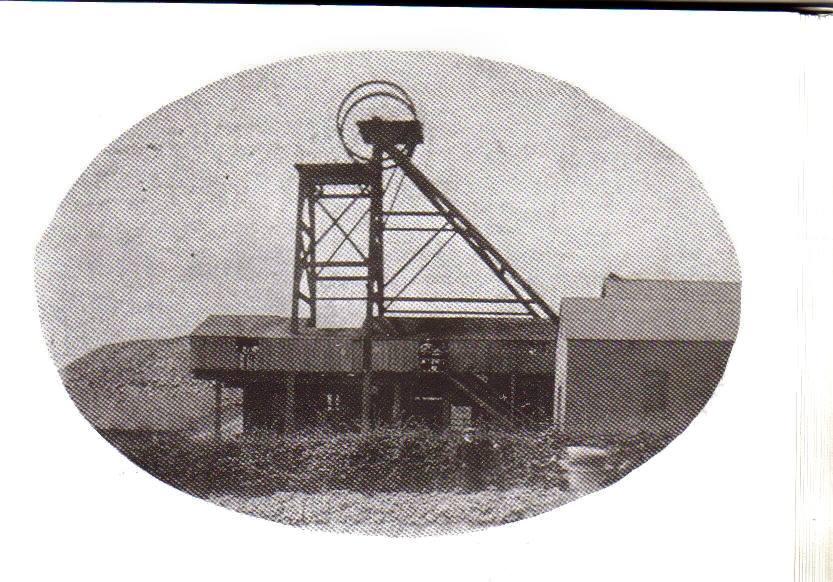
In 1897 Edwin Cunnah began operations in a ventilating shaft in the old tunnel which ran from Moss to Brymbo, and which had been closed in 1862. Cunnah sank the shaft to a lower depth, down to the top of the four-foot coal seam. Black Lane Colliery was also known as the Jubilee Pit as it was opened in the Queen Victoria’s Diamond Jubilee year. The mine was taken over by a Liverpool merchant, Mr Wilkinson who erected the headgear as it appeared in 1947. The mine later returned to the hands of Edwin Cunnah and was sold to Major Brown in 1910. Brown leased the pit until his death in 1923, but Cunnah maintained control over the sale and distribution of coal. After Major Brown’s death the colliery was taken over by the Black Lane Coal Company whose four Directors were W. Corbett, J.A. Williams (Brynteg), R.W. Griffiths (Pentre Broughton) and Hywel Cunnah.
Employee numbers varied throughout the time the mine operated; 79 men were working below ground in 1914, this had fallen to 23 in 1941 then more than doubled to 50 men by 1947. In 1938 the colliery had an annual output of 5000 tons of coal.
In 1937 a 14-year-old boy, T.R. Jones, was tragically killed when a lump of coal fell on him while he was clearing from the coalface.
Hywel Cunnal became the sole owner of Black Lane Colliery in 1947 and was granted a licence to operate it privately under the 1946 Coal Nationalisation Act. The following year a drift mine was opened from above Lodge to meet up with the Black Lane workings (Lodge Level, also known as Cunnah’s Level). This meant walking distances below ground were reduced and no winding gear was needed to lower men to the coalface. Hywel’s son, Donald Connah managed the drift mine. Black Lane Colliery was abandoned in 1957 due to the wet conditions within the workings
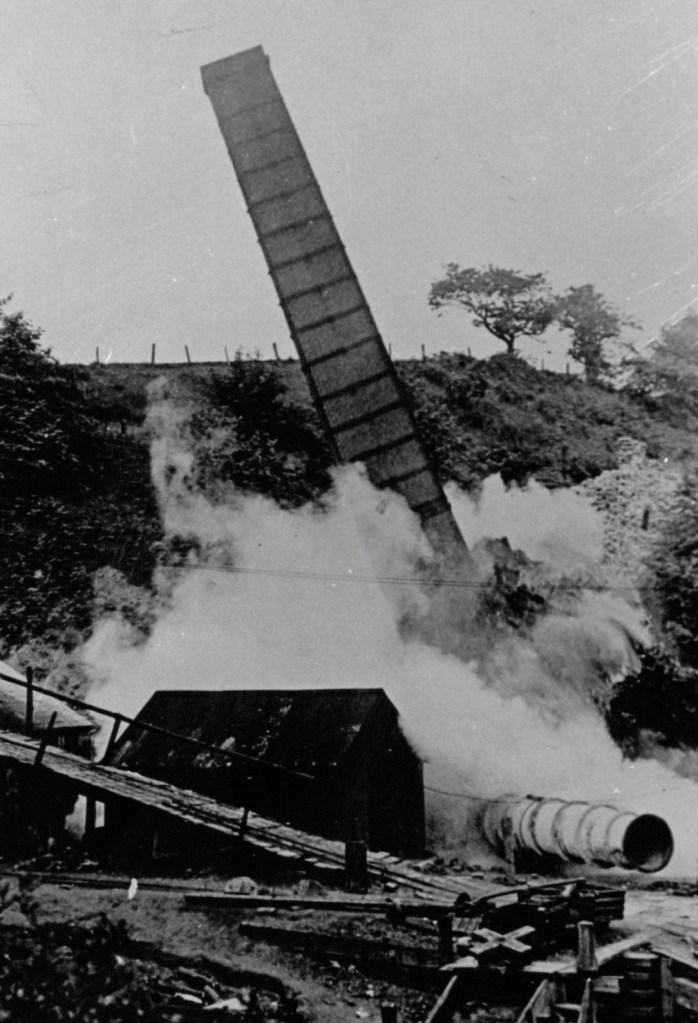
The Brynmally shaft was sunk in 1839 and operated for 96 years. Coal had been extracted from pits on the Brynmally estate from as early as 1770 when Charles Rowe of Macclesfield and James Venables began mining operations. They were followed by Richard Kirk whose son, George had to mortgage the estate due to financial difficulties. In 1849 the Brynmally estate was purchased by 23-year-old Thomas Clayton from Chorley, Lancashire. Clayton made his home at Brynmally Hall until his death in 1896. The colliery later passed to the hands of the Brynmally Colliery Company which continued production until it closed in 1935.
At the time of Clayton’s death in 1896 222 men were employed at Brynmally Colliery rising to over 500 in 1914.
During Clayton’s ownerships there were three serious accidents at Brynmally. On 26th September 1856 thirteen men were drowned when water flooded underground workings. In another incident on 27th January 1877 three men were killed in a fire and in the most serious tragedy on 13th March 1889, twenty men lost their lives in what was considered to be the worst pit accident in North Wales prior to the Gresford Mining Disaster in 1934. Eight of the twenty men killed at Brynmally on 13th March 1899 were under 16 years old and all lived in the villages close to the pit. The inquest into their deaths held at The Harp Inn, Moss Hill, found the tragic loss of so many young lives was the result of numerous breaches of safety rules at the pit.
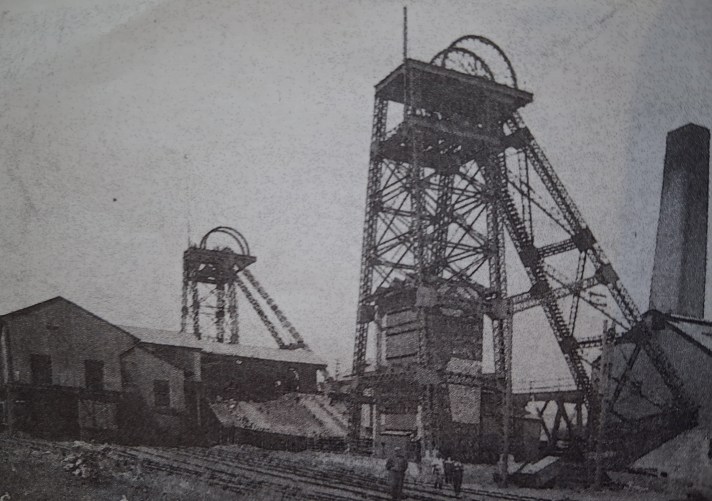
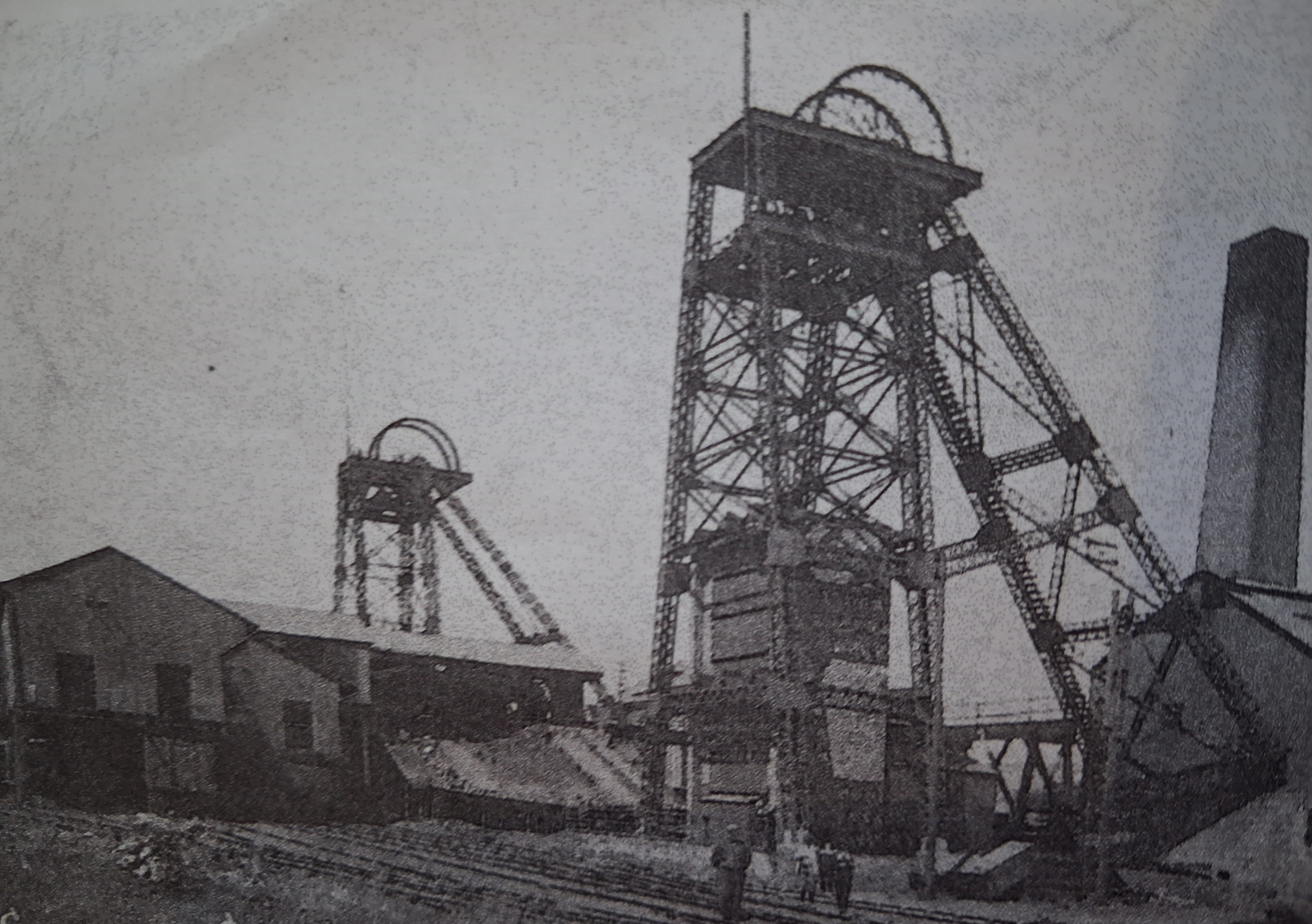
Opened in 1877, Gatewen Colliery belonged to the Broughton and Plas Power Coal Company. In 1914 it employed 816 men. The colliery had a restricted working area and by 1932 it was considered uneconomic to continue working and was closed that year. When the working headgear at Bersham Colliery was destroyed by fire in the 1930s it was replaced with the redundant steel pit head gears from Gatewen.
Plas Power Colliery had a reputation as one of the most modern pits in the country pioneered the use of electricity underground. Electricity generated at Plas Power was distributed for use at Gatewen.
Between 1957 and 1966 the site was used as a coal washery, and a disposal point for open cast mining at Plas Power Park. Subsequently it became an HGV training centre and is now a private residential housing estate, Gatewen Gardens.
The Holland Colliery was located closed to Halcog. Only a small site it had two inclines to excavate coal from the Crank and Powell seams. Holland Colliery closed in 1941.
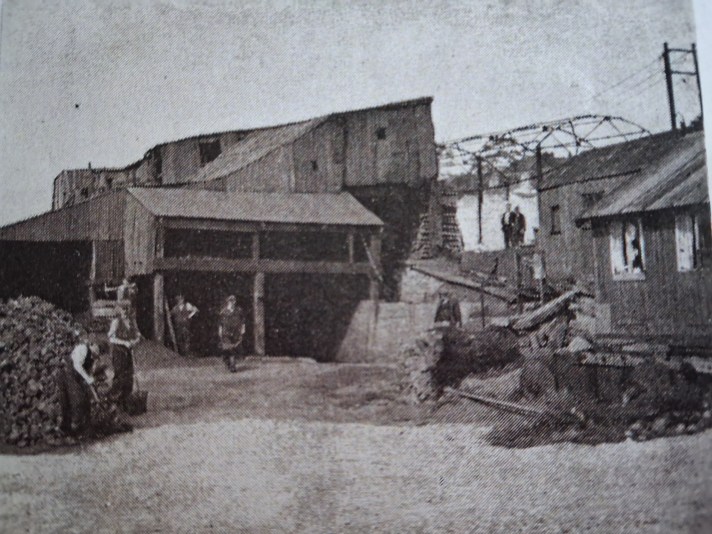
In 1948 a drift mine was driven above Lodge to meet the 4-foot seam at Black Lane Colliery. The shafts at Black Lane were eventually stopped and all coal worked from the Lodge Drift. Wet conditions underground together with the thickness of the seam resulted in the abandonment of operations at the Drift in 1957.
G.K. Johnson, colliery manager at Black Lane since 1947, retired from managing the Drift in 1952 and was succeeded by Donald Cunnah, son of the colliery owner Hywel Cunnah.
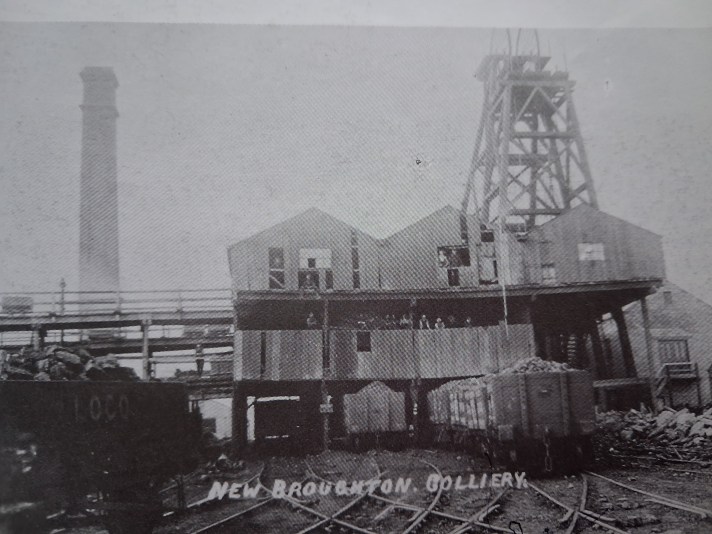
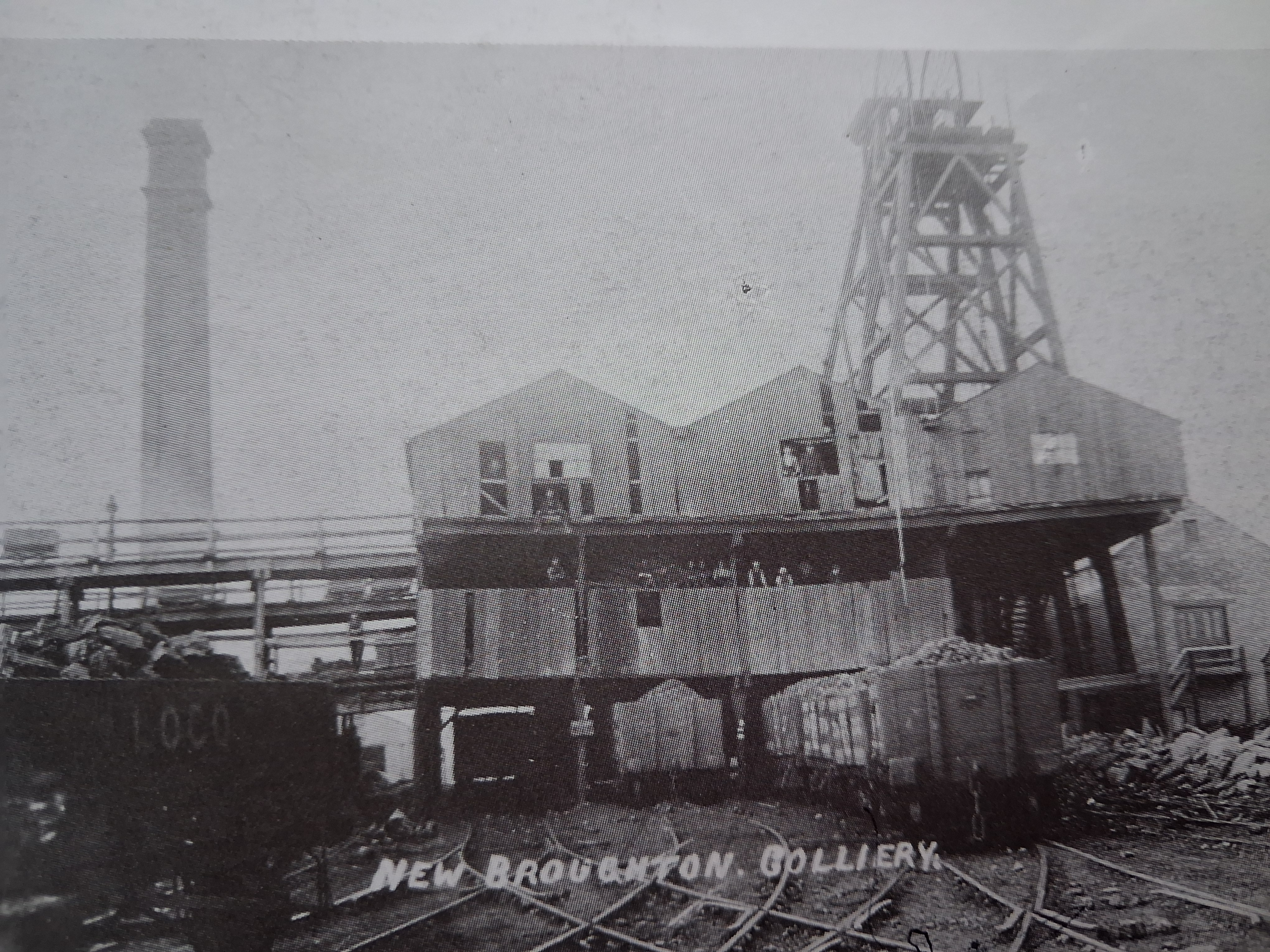
The New Broughton Colliery was sunk in 1883 by Thomas Clayton and thought to be his most profitable venture. Known locally as ‘Clayton’s Pit’, it was taken over by a Birmingham firm, Mitchell & Butler in 1900 and later by S.W. Higginbottom of Mold. 335 men were employed at New Broughton in 1901. The colliery was managed by Samuel and Edward Cunnah, brothers of Edwin Cunnah who had opened and owned Black Lane Colliery in Pentre Broughton in 1897.
Operations at New Broughton ceased in 1901 and the site was sold at public auction in 1911. In 2025, it is now occupied by Pat’s Coaches.
Broughton Colliery was situated close to Broughton Hall, near the site of the current play area on Solway Bank. The shafts were first sunk before 1850 and in 1883, when New Broughton Colliery opened, the prefix ‘Old’ was added to distinguish between the two operations. The colliery was founded by Rev. John Pearce and Richard Gough, owners of Southsea Colliery and the Broughton Hall Estate.
On 28th February 1868, the mine experienced severe flooding and so an 85-inch Cornish pumping engine was installed which began pumping in November 1869. Old Broughton was a prosperous colliery until 1878 when the mine was overwhelmed by a large body of water which broke through the Brymbo fault and drowned it out.
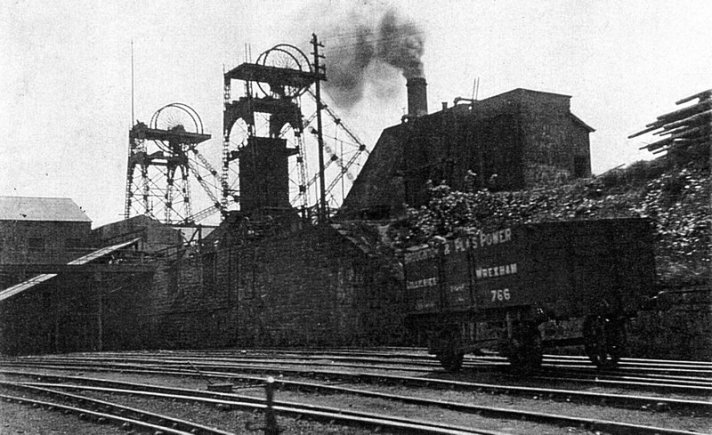
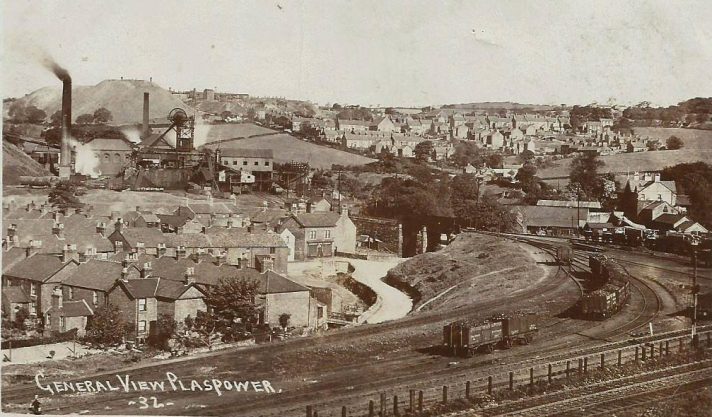
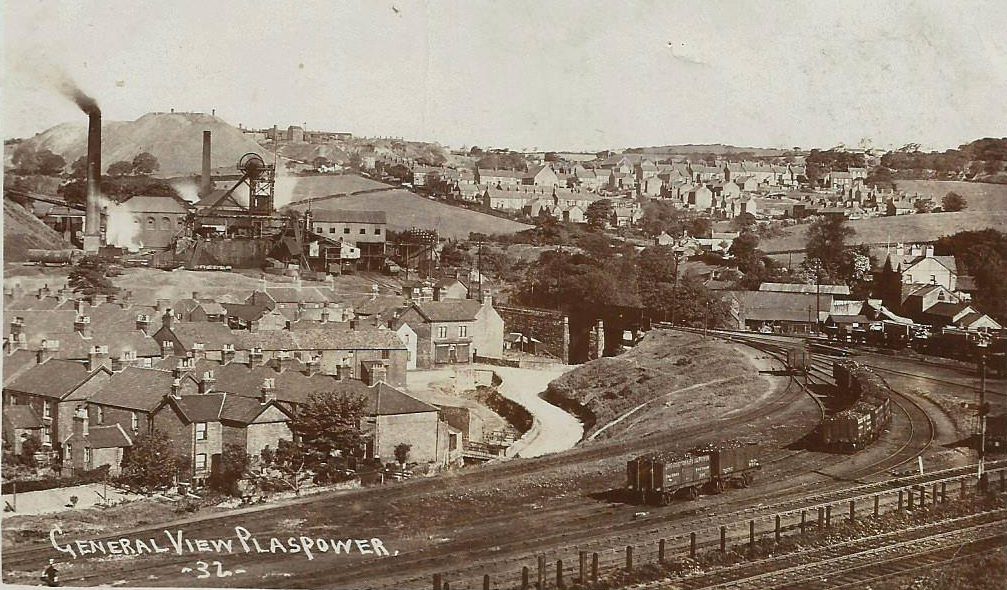
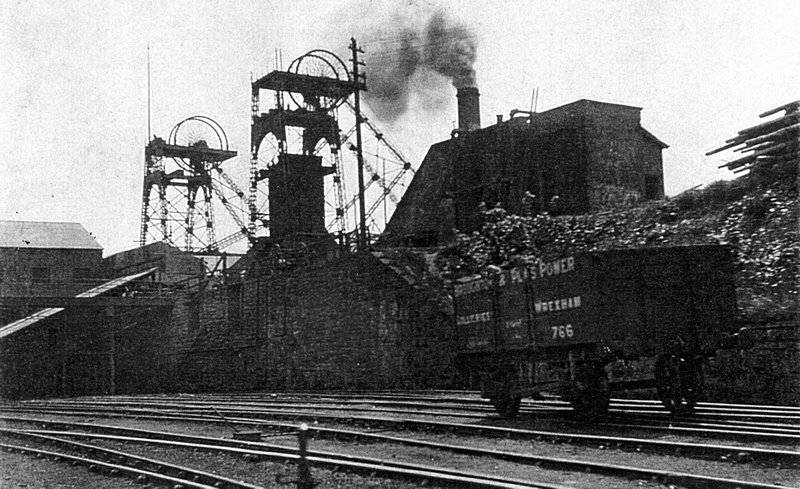
Plas Power was one of the largest collieries in the area, employing over 1000 men in 1901. First sunk in 1885, it was regarded as one on the most modern pits in Wales and pioneered the use of electricity underground, attracting visitors from as far afield as Japan to see it in operation. Plas Power also supplied electricity to the Vron and Gatewen collieries. The high quality of coal produced at Plas Power meant it was suitable for use for railways and shipping, and it counted Indian railway companies, P&O and Cunard among its customers. Production ceased in 1938 resulting in the loss of 620 jobs.
In 1885 the fears of local men who felt their jobs were threatened by an influx of Irish workers led to violence at Plas Power and the following year there was rioting when men from neighbouring pits objected to men from Plas Power sending up 21 cwt. of coal to the ton rather than the usual 20 cwt and so producing more coal to the ton than the neighbouring pits.
The site was linked to the main rail line which ran alongside the Solway Bank coke ovens by a bridge. It’s railway wagons bore the name ‘Broughton and Plas Power’, a company formed by Henry Robertson, William Henry Darby and Charles Edward Darby who had acquired mineral leases in the area.
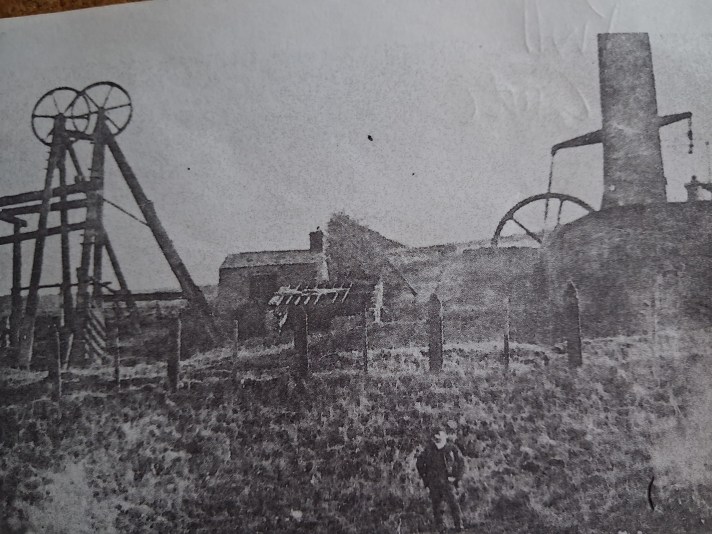
Pwll Cadi (Katie’s Pit), was situated near the Great Western Railway station at Brymbo (Lodge), and close to the tunnel which carried coal from Brymbo via Moss and Summerhill to the mainline near the Wheatsheaf. The pit was forced to close in 1868 when a great volume of the water which had flooded Old Broughton colliery seeped through to the Pwll Cadi workings.
There were four shafts on the site. One, known as the Sefton Pit, was located below the Black Lane Presbyterian Chapel. The second was near the site of Brymbo GWR station and a further two were above the railway line adjacent to The Royal Oak public house, also known as ‘Cadi’s’, on Long Lane.
Pwll Pitar (Peter’s Pit), was located on the site of the Bethel Wesleyan Chapel in Brymbo. It was worked from 1846-7 and was most likely abandoned when Pwll Cadi and Westminster Collieries were developed.
Southsea Colliery was located between Bridge Street and Church Street in Southsea. Owned by Richard Kirk of the Brynmally estate in 1812, the first cart weighing machine in the neighbourhood was installed here, coal previously having been sold by measure rather than by weight. In the 1830s the Rev. John Pearce and Richard Gough, a tobacconist, restarted the colliery as well as sinking Old Broughton pit and building Broughton Forge. Their venture at Southsea failed in 1853 and in 1855 the site was purchased by the partnership of Henry Robertson, William Henry Darby and Charles Edward Darby who formed the Broughton Coal Company.
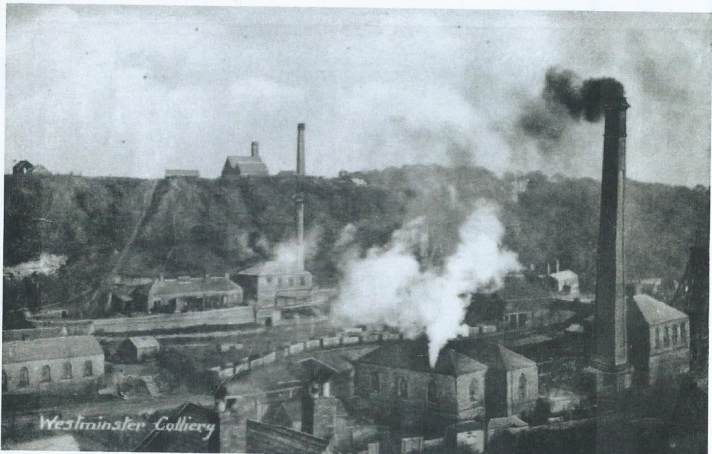
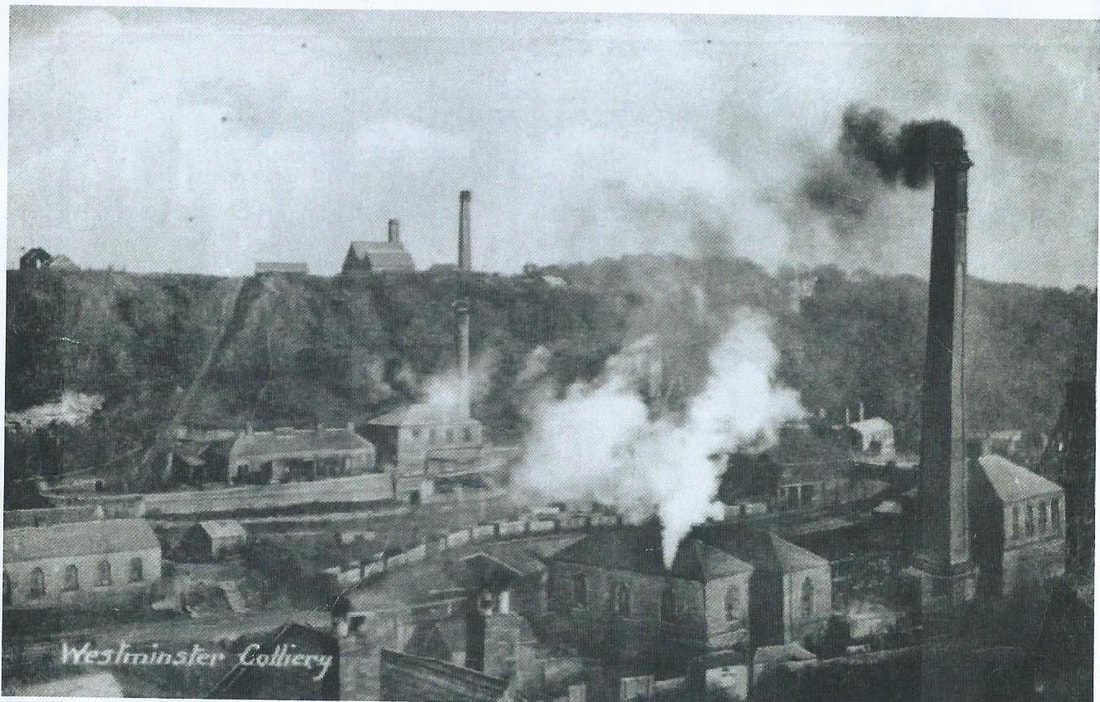
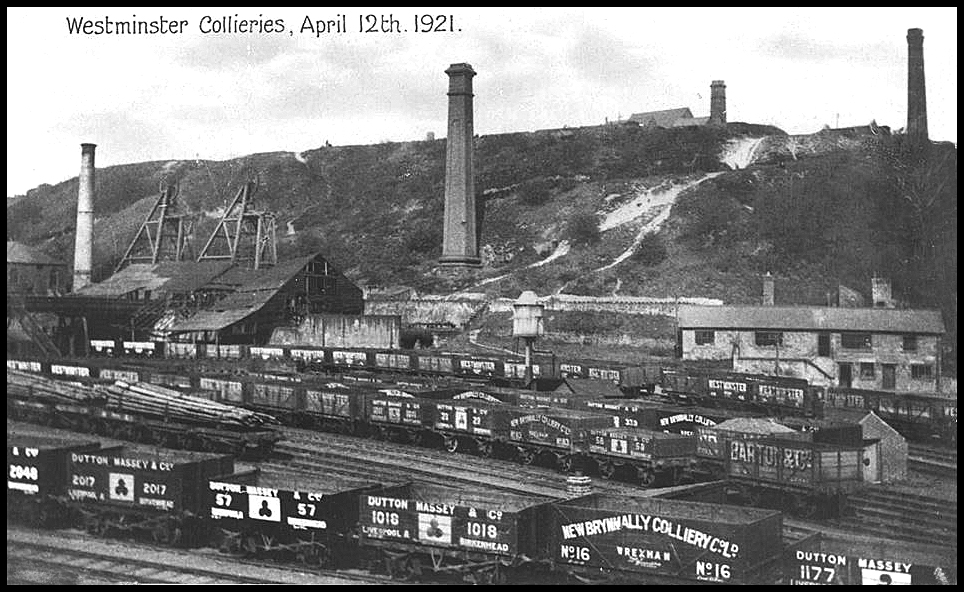
This colliery was located in Moss at the north end of what is now Moss Valley Country Park. Outcrop workings began in the 18th Century and by the mid-19th Century operations had been extended by the sinking of five shafts on the site. The first shafts, numbered 1 and 2, were sunk by local coalmaster Thomas Clayton at Summerhill and the later ones, numbered 3,4 and 5, were sunk in the Moss Valley. The colliery was managed from the mid-19th Century by Samuel Jones, Colin Napier, Thomas Jones, John Jones, Ishmael Jones, John Salisbury, Ellis Evans, William Jones and Edward Davies who was colliery manager when the site closed on 25th February 1925 at which time it was owned by the Westminster Brymbo Coal & Coke Company.
Westminster Colliery was the first in the area to introduce coal cutters. Coal was transported from the site by road until 1847 when a tunnel was opened connecting Moss and the valley mines to the GWR main line via Wheatsheaf Junction. The tunnel closed in 1908 when a branch line from Moss to Wrexham branch line was opened, making it obsolete.
In 1923 991 men were employed here. The worst accident at the site occurred in December 1850 when two boys were killed in a fire. During the miner’s strike in 1882 there were serious riots at the colliery. Police were called out from Wrexham to relieve the besieged colliery management but were driven back uninjured by the striking miners. Order was only restored after the military were called out and the Riot Act read at Mr Harrop’s house at Cerney.
This was a small drift mine or level, owned by Hywel Cunnah and situated near the Tunnel Inn on Brake Road, Moss. The site operated from 1941 to 1947 and employed up to 20 men.
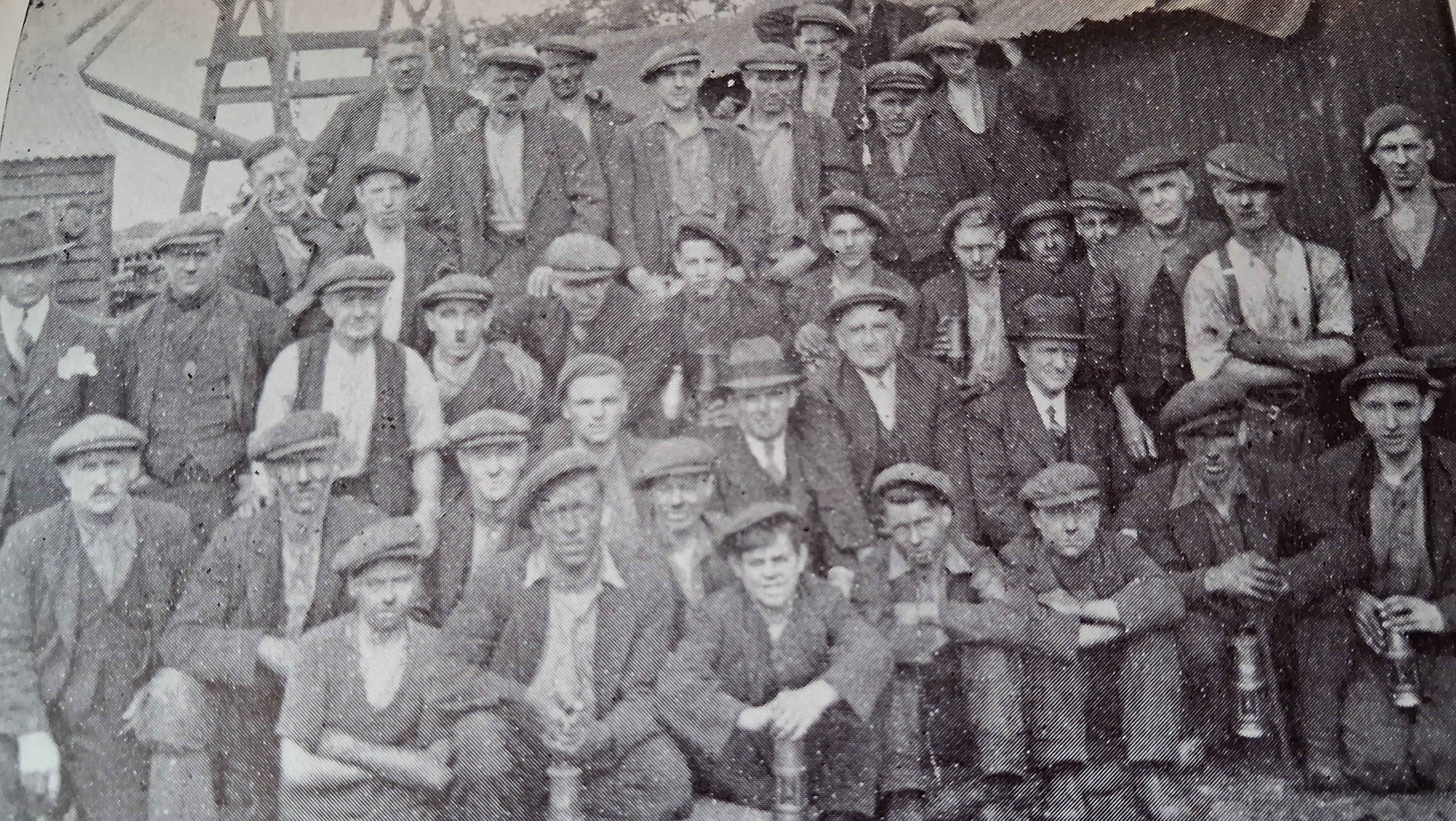
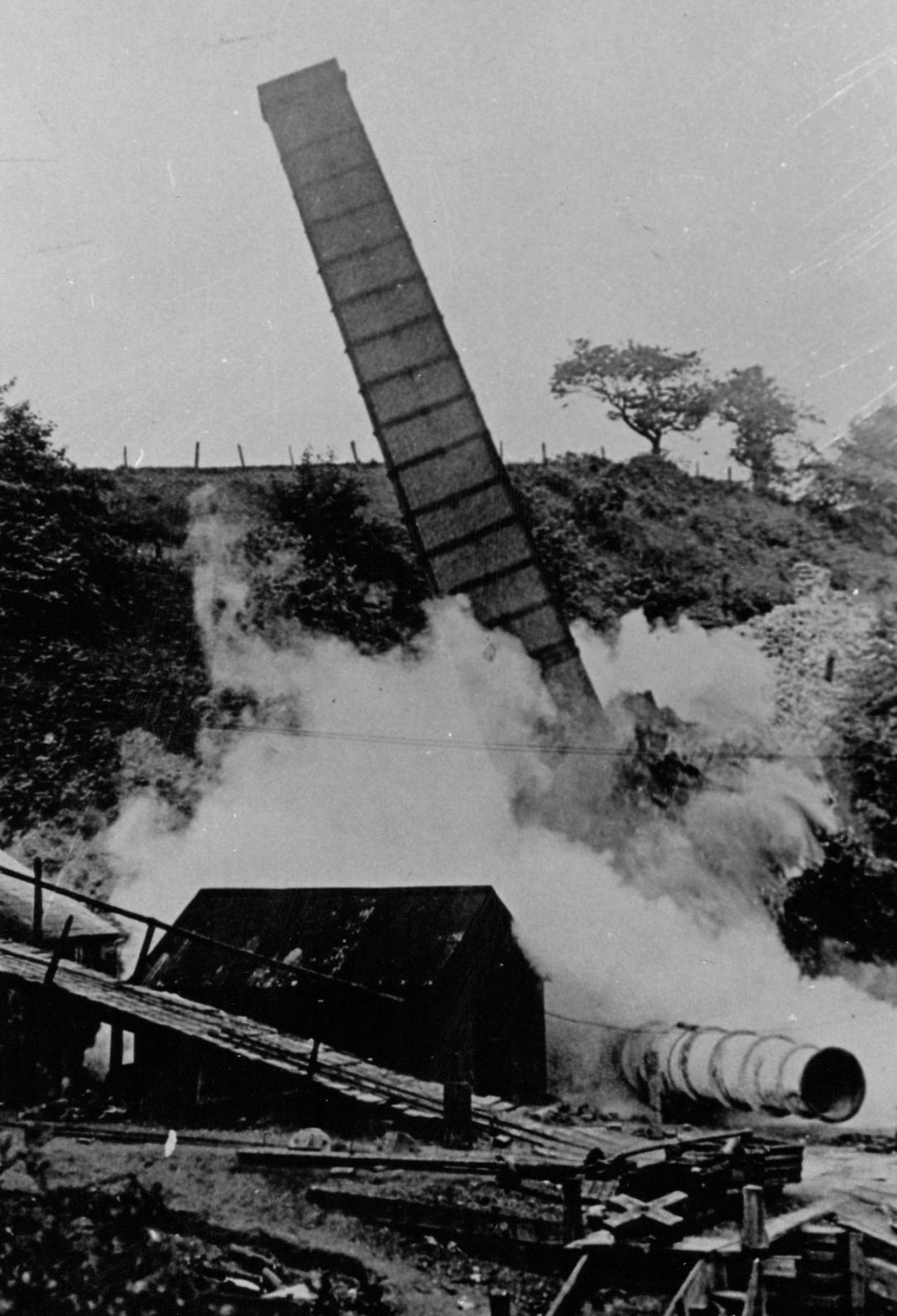
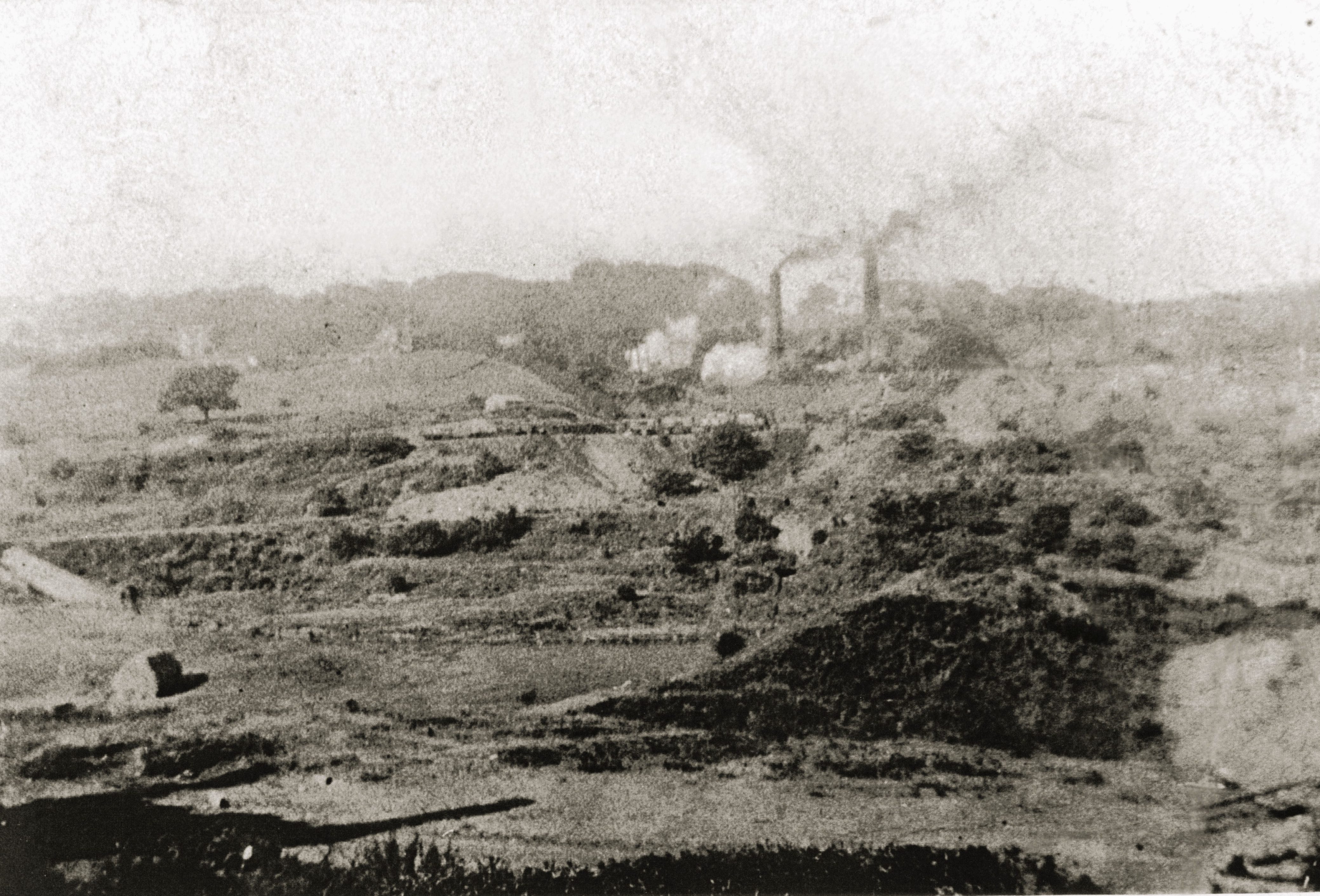
Collieries Gallery
(Click an image to enlarge the gallery)
📚 Sources
- Lerry, G.G., Collieries of Denbighshire (1946)
- Bagshaw, John, Broughton Then and Now (1992)
📨 Call for Contributions
If you have memories, photographs, or information about any of the collieries in the Broughton area, we’d love to hear from you.
Email: editor.broughtonhistory@btinternet.com
 Broughton District History Group